Samantha Magid
Applied and computational mathematician studying scientific productivity, stochastic processes, computational social science, and generative modeling. Researcher at the Science and Humanity Lab. Unapologetic gay woman in STEM.
Research · Publications · CV






“A beach is made of what is there.”
— Excerpt from a long-forgotten Oceanography 101 assigned reading
The black beaches of Hawai’i form from pulverized lava; the glass beaches of Fort Bragg, from old garbage dumps; the beaches of Cape Cod, from Laurentide sediments crushed by the stormy North Atlantic. And then again, the lava of Hawai’i comes bursting from the depths of the Earth, the glass of Fort Bragg from old kilns and factories that melted sand, and the sediment of Cape Cod via glacier from countless miles northwest. Each is a beach, yet each is distinct: a whole inseparable from its parts, while its parts are themselves wholes inseparable from what was there in turn. We are all made, recursively, of what is there.
The task of science is to explain what is there without explaining it away.
Current Research
My current research at the Science and Humanity Lab seeks to identify a discrete compartmental approximation of the generative process of scientific productivity trajectories using computational Bayesian approaches on large datasets from the Academic Analytics Research Center and OpenAlex. I aim to close a gap in and harmonize current science-of-science literature with a transparent, adaptable, and interpretable mechanistic model that will bring about an improved understanding of scientific productivity.
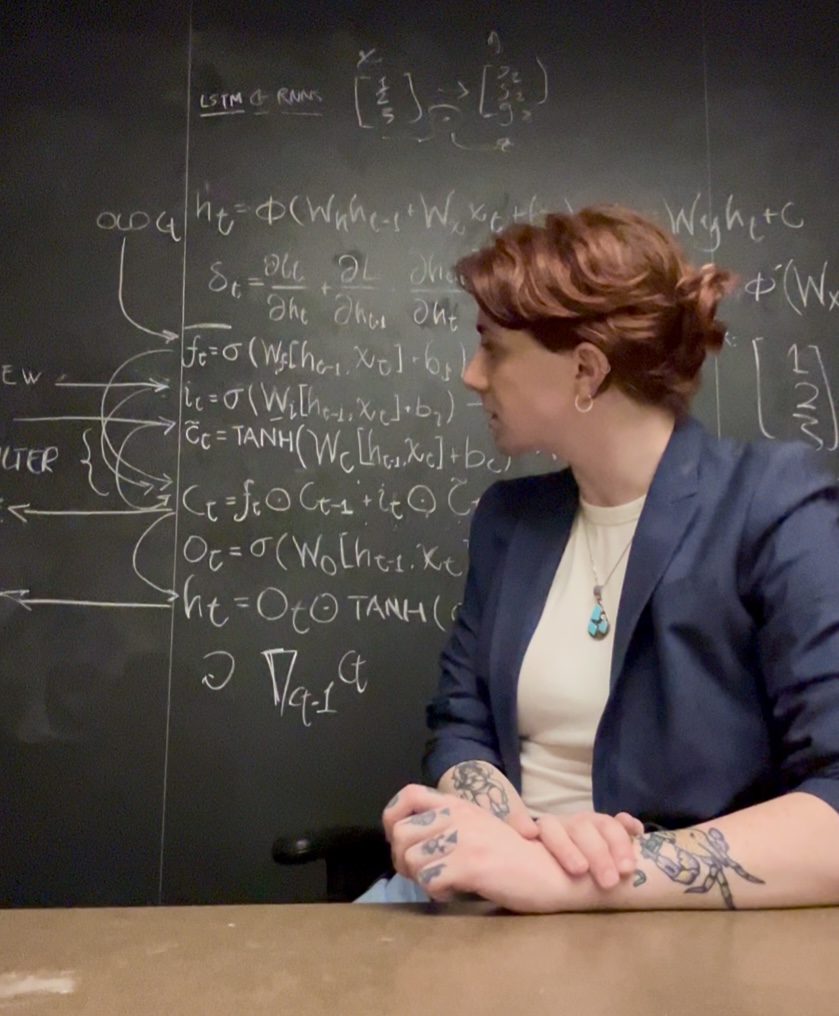
Independently, I use multi-agent and NLP-enabled approaches to analyze the use of causal inference across many scientific domains. This includes assessing the strength and correctness of chains of causal reasoning and deduction in large corpuses, expanding on a recent Nature Human Behaviour paper. I am also developing and appraising the behavior of neural network architectures composed of multiple layers of varyingly-stochastic LSTMs, an expansion on StoxLSTM. Read more about my research →